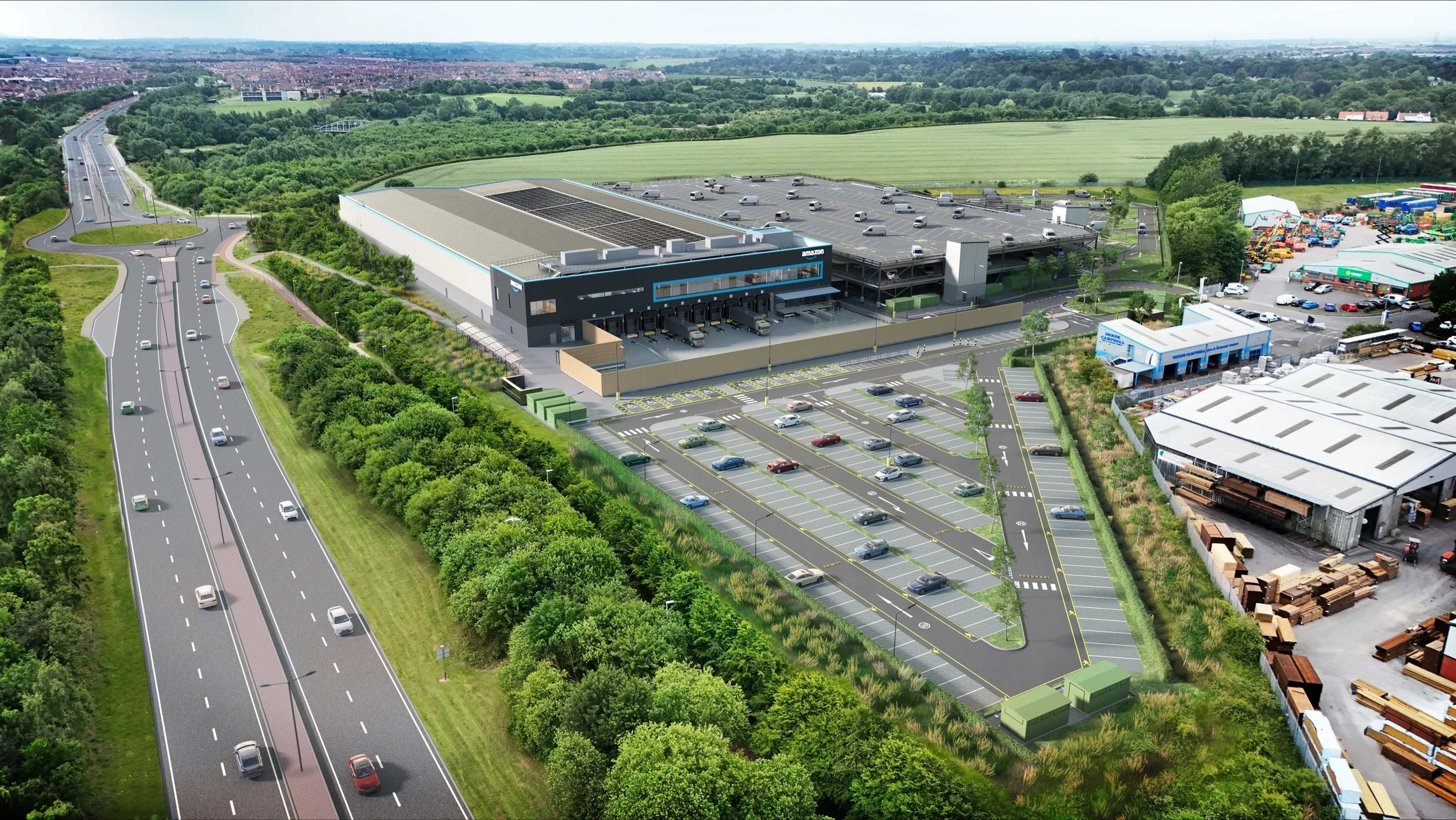
The news was initially published on Amazon’s website: How Amazon is investing in innovation to decarbonise construction in the UK.
Installed alongside other innovative concrete solutions, this infrastructure project marks an important step in demonstrating a complete commercial application in a demanding environment and building confidence in carbon-storing materials across the construction value chain.
Building confidence through real-world performance
Our Rebond series is a new generation of cementitious materials designed to store more carbon than is emitted in its production. Our products can be incorporated into concrete as a partial replacement for conventional clinker-based cement, where we have demonstrated cement replacement rates of 10-30%, whilst delivering strong technical performance together with carbon emissions savings.
At Stockton-on-Tees in the United Kingdom, the monitoring programme will provide evidence of how the installed concrete performs in use. That experience is important for asset owners, designers and concrete producers considering the material for larger and more demanding applications.
By putting emerging materials into a working delivery station, Amazon is helping establish the practical references for the industry that support future qualification and specification.
Our ambition is to broaden the construction industry’s material options with high performance carbon-efficient and energy-efficient alternatives. Since day one, we have been committed to working closely with the market to develop a superior product, not just from a sustainability angle, but also designed to meet our customers’ performance needs.
After seeing strong demand from ambitious early adopter customers such as Amazon, we are now gearing up to substantially increase our production capacity to meet the growing demand. Our first commercial-scale plant is the next step towards supplying our products at industrial scale, with the product specification design informed by feedback from over 20 customer projects delivered to date.
Bringing the value chain together to scale carbon-storing materials
For us, value chain orchestration is critical to the speed of adoption. An asset owner creates demand, designers specify the material, concrete producers integrate it into their mixes, and construction teams put it to work. Moving quickly depends on these teams sharing the ambition and working through the requirements together. When the whole value chain is aligned, innovation has a faster route from development to deployment.
On this application, Amazon brought together several construction technologies: alongside Paebbl, the site uses CarbiCrete’s cement-free paving and asphalt containing Low Carbon Materials’ ACLA® additive, supplied as part of Holcim UK’s Foamix Eco. The site is pursuing Zero Carbon Certification from the International Living Future Institute, with formal assessment to follow a full year of operational data.
When an infrastructure owner chooses to work with a new material, the project can generate practical experience for the producers, engineers and construction teams involved. That experience can inform subsequent decisions about specification, concrete production and delivery, as we’ve experienced. We are pleased to have worked with our strategic partner Holcim on the project.
We are grateful to early adopters such as Amazon for helping establish these real-world references. Their value grows when they help the wider industry see a credible route to using carbon-storing materials.
The choices made in today’s projects establish how the next generation is built. The invaluable experience from this industrial application has already informed the design of our first commercial plant, helping us build our product and production capacity around real market requirements.
If your projects could take material from our first commercial plant’s early years, we’d love to hear from you.